A well-maintained car costs less over time and breaks down less often at the worst moment. The catch: not everything is done at the same rhythm. Here is a maintenance schedule by distance and time steps, with what to check or replace at each one, and how to never forget anything.
How to read a maintenance schedule
Your car’s owner’s manual always has the last word: for each part it gives a distance and a time limit, and whichever comes first counts. A car that hardly moves still needs servicing at least once a year. The ranges below are common orders of magnitude: check them for your model.
The checklist by step
| Step | What to check or do |
|---|---|
| Every month, and before a long trip | Tyre pressure (cold), oil level, coolant level (cold), washer fluid, lights and brake lights |
| Every 10,000 to 15,000 km (6,000 to 9,000 miles), or 1 year | Oil and oil filter change; condition of brake pads and discs; tyre wear and rotation if the manufacturer recommends it; fluid levels; wiper blades |
| Every 20,000 to 30,000 km (12,000 to 18,000 miles), or 2 years | Air filter; cabin filter (often sooner in town or on dusty roads); check of the suspension, exhaust and drive-shaft boots |
| Every 2 years | Brake fluid: it absorbs moisture over time, even when the car hardly moves |
| 30,000 to 60,000 km (18,000 to 36,000 miles), depending on the model | Spark plugs (petrol); fuel filter, especially on a diesel |
| 4 to 5 years, or 60,000 to 100,000 km (36,000 to 60,000 miles) | Coolant; battery check (it often lasts 4 to 6 years) |
| Per the manufacturer: 100,000 to 160,000 km (60,000 to 100,000 miles), or 5 to 10 years | Timing belt and water pump, if your engine has a belt (some have a chain with no fixed interval) |
| From 80,000 km (50,000 miles) | Shock absorber check; watch tyres by their age (over 6 years) as much as by wear |
The due dates that do not depend on distance
These are the ones people forget the most, and they cost the most when missed:
- Insurance: the renewal date and, depending on the contract, the notice period to cancel or switch.
- The roadworthiness inspection: how often depends on your country and the age of the car. A re-test is sometimes required within a set time.
- The annual road tax or fee, where there is one.
- Licence and registration: change of address, owner or vehicle.
When to shorten the steps
If you mostly make short trips, drive in town with a lot of stopping, tow, drive loaded, or drive in dust, extreme cold or heat, your car is in “severe service”: the manual then gives shorter intervals, often about half for the oil change.
How to keep your schedule without thinking about it
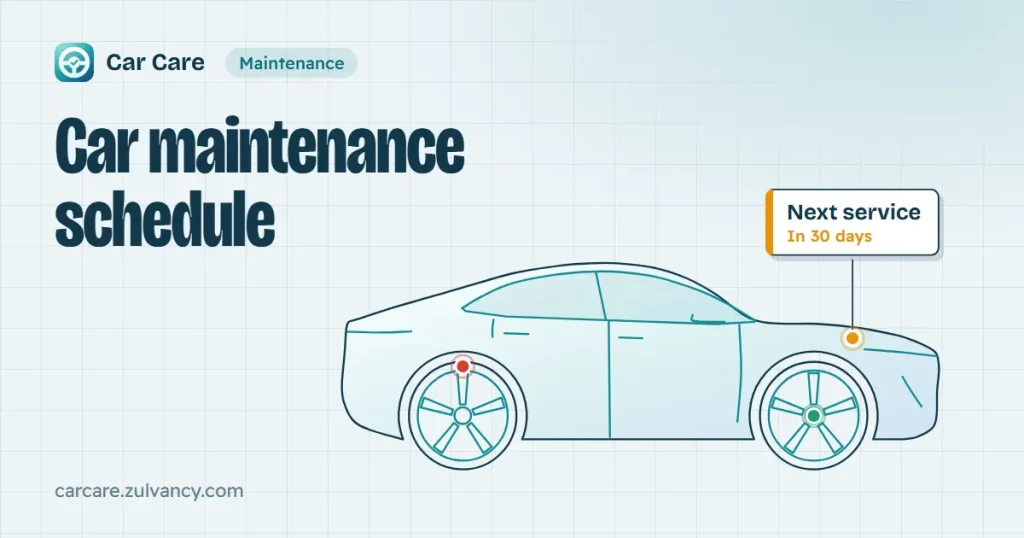
Write down the date and the mileage at every service, and keep the invoice. With Car Care you track up to 25 parts and due dates: the app shows the days left, turns each part green, then orange, then red, and sends a notification before the due date, even when the app is closed. You can share the vehicle with your family through the family garage, and export the maintenance log as PDF or CSV, handy when you sell.
Frequently asked questions
Do you have to service the car at the manufacturer’s garage to keep the warranty?
It depends on your country and your contract. In many countries, including the European Union, an independent garage can service the car without voiding the warranty, as long as the manufacturer’s schedule is followed and the invoices are kept. Read the terms of your warranty.
What should you do with a used car whose history you do not know?
Treat the oil change, filters, brake fluid, coolant and timing belt as “to check” and have them inspected. Write down the date and mileage you start from: your own schedule begins there.
How often should the brakes be checked?
At least once a year, and whenever the tyres are changed. A grinding noise, a spongy pedal or a brake warning light calls for an immediate check.
Is servicing more often useful?
Shortening an interval does no harm but costs more: the right setting is the manufacturer’s, adjusted to how you drive.
These are general guidelines: when in doubt, your owner’s manual or your garage has the last word.